A day with the builders at ChemAI 2026
At ChemAI x Deep Tech Builders in Amsterdam: why AI for science is still up for grabs, what investors and corporates were asked to change, and the conversations I brought home for Quantanomous.
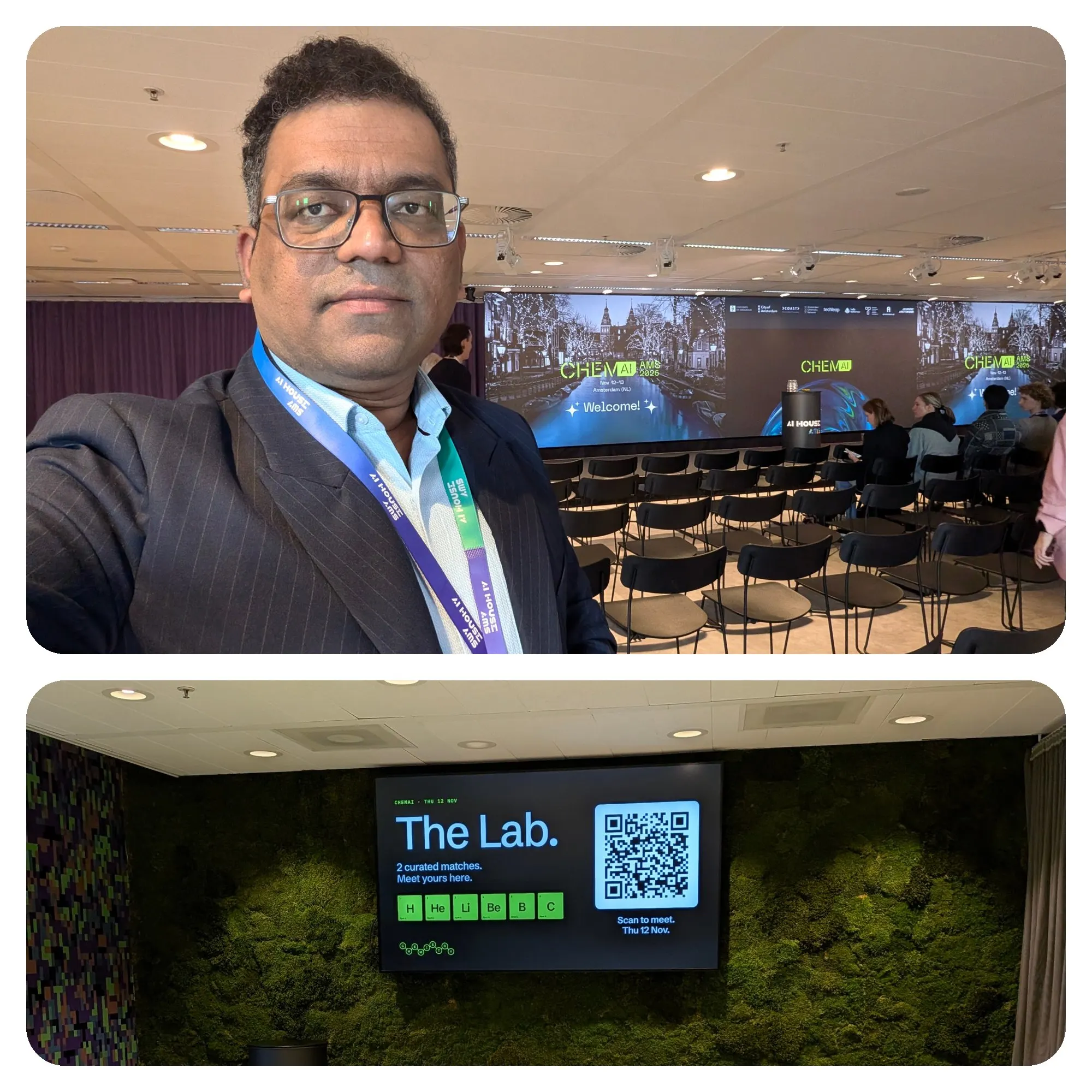
On Thursday 12 November, I spent the day at AI House in Amsterdam for ChemAI x Deep Tech Builders, the first day of ChemAI 2026, representing Quantanomous. The day was sold out. Its panels moved between three subjects: how fast the technology is moving, how companies innovate with it, and how the funding scene is changing.
Science takes time
One of the first slides of the day put a number on something every scientist knows. Drawing on Gross and colleagues (Energy Policy, 2018), it showed how long technologies took to go from invention to widespread commercialisation. LCD televisions took about twenty years, lithium-ion batteries roughly twenty-five, and solar photovoltaics and cars close to fifty. For many of them, most of those years went into invention, development and demonstration.
In materials, much of that time is the loop between a promising idea and a measured sample, repeated until something works. Shortening that loop is why Quantanomous exists.
Europe has to take more risk
Yoram Wijngaarde, founder and CEO of Dealroom, brought the data. US companies lead 14 of 21 critical technologies. European companies lead three: server operating systems, mobile chips and EUV lithography. Four fields have no leader yet. AI for science is one of them, alongside quantum computing, humanoid robots and fusion.
Europe’s position is improving. Its share of global VC-backed enterprise value has roughly tripled, from 4.1% for companies founded in the 1990s to 12.6% for those founded in the 2010s. Europe now counts 50 decacorns, 11 of them new this year. One figure stayed with me, though. Since 2020, European founders have started 28.8% of the world’s VC-backed startups, yet those companies hold only 12.2% of the value. Europe starts companies; it does not yet scale enough of them.
His prescription matched the numbers. European investors should take more risk: invest fast, fail fast. Large corporations should work with startups without the red tape and stop trapping them in procurement cycles. They should also take the risk of buying from startups early, because early traction is what a deep-tech startup needs most.
A view from the Bay Area
Christian van der Woude, senior advisor for science, technology and innovation at the Consulate General of the Netherlands in San Francisco, described what he sees from the Bay Area:
- AI scientists are entering the lab: Edison Scientific’s Kosmos is being deployed with national lab teams.
- Autonomous labs are scaling from demonstrations to networks: companies such as Lila Sciences now work with national labs on self-driving experimentation.
- Materials and chemical companies are putting AI co-scientists to work across their R&D.
- The government is building the platform: the Genesis Mission spans the 17 national laboratories, with 342 institutions in its first teams.
He showed the synergies between the two continents and the room for collaboration. He argued that the Netherlands should partner with the US while building a critical node in Europe. The tools for that are already in place:
- Invest-NL’s Deep Tech Fund, now €610 million
- the European Innovation Council’s STEP Scale-up, with €10 to 30 million in equity
- the new Scaleup Europe Fund
- the AI Factory in Groningen
- RAISE, the EU’s new Resource for AI Science in Europe
He closed with a QR code for registering for the programme.
Catalysts, then and now
Dr. Hanne Falsig of Topsoe gave an excellent presentation on how catalysts were made historically and how Topsoe, founded in Denmark in 1940, became a leading name in catalysis. She also showed how much research is still under way there. I agree completely with her closing point. AI for materials will take computer science, modelling, advanced analytics and laboratory automation working together, on top of deep expertise in the chemistry itself.
Two programmes for startups
Marieke Smidt of Oost NL presented the Big Chemistry Startup Program. It supports startups working across chemistry, AI and robotics with grants of €125,000 to €200,000 per project. Peter Westerhuijs presented TTT-AI, the national programme for AI startups, which offers venture building, entrepreneurial support and access to funding. I spoke with Peter before the panel, and afterwards I gave Marieke a short presentation of Quantanomous.
Two curated matches
ChemAI ran a matchmaking room called The Lab, which paired attendees with investors. My two matches were Invest-NL and Pjotr. Pjotr was pressed for time, so we have continued the conversation on LinkedIn. At Invest-NL, I talked with Maaike Vranckaerts and David Drost about funding possibilities and explained the idea behind Quantanomous. Invest-NL invests at a later stage than ours, so I promised to come back in about two years, with results to show.
The people I met
Conferences pay off in the hallway, and I met many researchers, engineers and founders working on related problems. VSParticle, a Delft company that builds nanoparticle printers for materials research, presented its work, and we talked about a possible partnership, either for experimental work or through their instruments.
What I took home
It was a day full of connections, and a rare high-level view of where chemistry, AI and investment stand together. The message I heard most often was that the technology is ready to be tried. What Europe needs now is people willing to try it early: investors who move fast and corporates willing to be first customers. If you are one of them, I would be glad to talk.
Thank you to the Amsterdam Chemistry Network, AI House and all the partners for a well-run day.
Read the Quantanomous summary of the day on quantanomous.com.
About the Author

I'm Dr. Ravindra Shinde, a computational physicist and quantum chemist. My work spans quantum chemistry, condensed matter physics, AI for materials, and scientific computing: I use and develop electronic-structure methods to understand how electrons shape the properties of molecules and materials, and I build the software that makes those calculations possible.
Continue reading
Four minutes in Luxembourg
Pitching Quantanomous at Luxembourg Venture Days: one idea, one deadline, a decision that did not go our way, and the conversations that came after.
Selected for Google for Startups Immersion
I have been selected for Google for Startups Immersion, powered by Antler: years of high-accuracy materials modelling, now inside a product, and a programme built to take it further.
A day at Amazon Amsterdam
A day at Amazon's Amsterdam office for Claude Code on Amazon Bedrock, a hands-on AWS workshop on building with Claude, and knowledge to carry into upcoming ventures.